Show Me the Money
As a Video Production educator, I often am asked, “How can I make money doing this?” That is a great question and worthy of an answer. Often times, when people think of careers in Video Production, their focus is narrowed into a small corner of the industry. In actuality, there exists a wide gamut of jobs that are viable and realistic career options for those that wish to pursue them. This short article will list some of these options and hopefully pursue them in greater detail in the future.
Photo by Tom Wilson
The Obvious Choices
The obvious choices are those careers which immediately come to mind when thinking of Video Production. These include jobs in: broadcasting, videography, film and video editing, camera operators, multimedia artists, and animators.
Broadcasting and Sound Engineering Technicians – According to the Bureau of Labor Statistics, these jobs are mainly concerned with:
-
Broadcast and sound engineering technicians set up, operate, and maintain the electrical equipment for media programs.
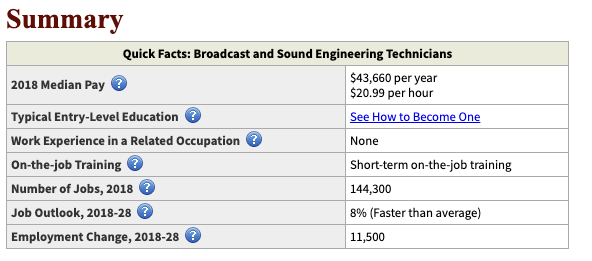
These jobs according to the most recently published statistics available (2018) pay a median salary of $43,660 per year or $20.99 per hour. Additionally, there is a projected to growth 8 percent from 2018 to 2028, which is much faster than the average for all occupations. This growth is expected to come from: “businesses, schools, and entertainment industries seeking to improve their audio and video capabilities. They will need technicians to set up, operate, and maintain equipment”.
You can find more information here.
Videographer – According to the Bureau of Labor Statistics, these jobs are mainly concerned with:
-
Videographers set up, operate, and maintain the cameras and other video equipment.
These jobs according to the most recently published statistics available (2018) pay a median salary of $54,570 per year or $26.24 per hour (B.L.S.).
You can find more information here: here.
Film and Video Production and Editors and Camera Operators – According to the Bureau of Labor Statistics, these jobs are mainly concerned with:
-
Shoot and record television programs, motion pictures, music videos, documentaries, or news and sporting events
-
Organize digital footage with video-editing software
-
Collaborate with a director to determine the overall vision of the production
-
Discuss filming and editing techniques with a director to improve a scene
-
Select the appropriate equipment, such as the type of lens or lighting
-
Shoot or edit a scene based on the director’s vision
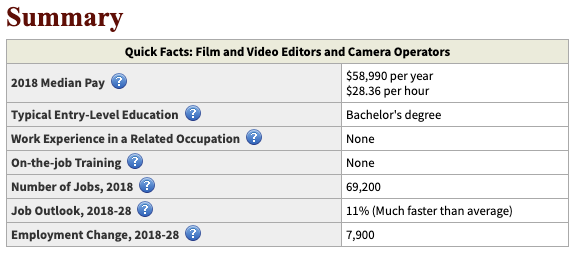
These jobs according to the most recently published statistics available (2018) pay a median salary of $58,990 per year or $28.36 per hour. Additionally, there is a projected to growth 11 percent from 2018 to 2028, which is much faster than the average for all occupations. This growth is expected to come from: streaming and other internet-only platforms (B.L.S.).
You can find more information here.?
Multimedia Artist and Animator – According to the Bureau of Labor Statistics, these jobs are mainly concerned with:
-
Multimedia artists and animators create images that appear to move and visual effects for various forms of media and entertainment.
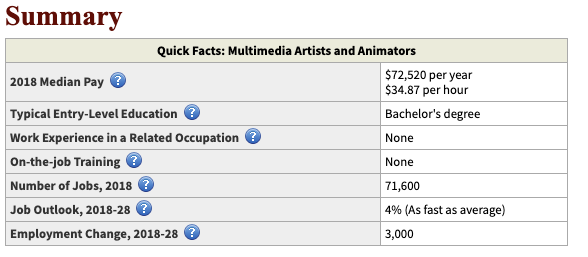
These jobs according to the most recently published statistics available (2018) pay a median salary of $72,520 per year or $34.87 per hour. Additionally, there is a projected to growth of 4 percent from 2018 to 2028, which is about on track with average for all occupations. This growth is expected to come from: increased demand for animation and visual effects in video games, movies, and television (B.L.S.).
You can find more information here.?
Summary of the Obvious
These more obvious jobs related to video production are stable, long-term, career worthy choices that a young person should investigate as a means of providing a worthy living wage. According to the government’s Bureau of Labor Statistics (B.L.S.) the median yearly wage for these media communication careers range from $42,000-$70,000 well above the annual median wage for all U.S. workers of $36,200. Remember that is the median yearly wage, which means it is the mid-point. There are people in these careers earning much higher salaries and some earning lower. This range depends on a variety of details such as education, experience, geography, demand, etc.
Not-So Obvious Options
In addition to these obvious options, there are less than obvious choices when it comes to video production careers and related careers that are worth your time to research. These jobs include specialist and general categories such as:
-
Freelance Videography
-
Wedding and Event Videographers
-
Social Media Videographer
-
Producers and Directors
-
Marketing & Advertising
-
Communication Specialist
-
Social Media Manager
-
Public Relations
-
Journalist
-
On-Camera Talent
-
Real Estate Videography
-
Drone Videographer
-
Social Media Influencer
-
Youtube Content Creator
-
Video Production Teacher
Where Do I Go From Here?
As you can see there are a myriad of options for High School Video Production students to consider for their future. I encourage all Video Production instructors to incorporate employment research into their curriculum. A great source of information for students and teachers alike is the Bureau of Labor Statistics website.